
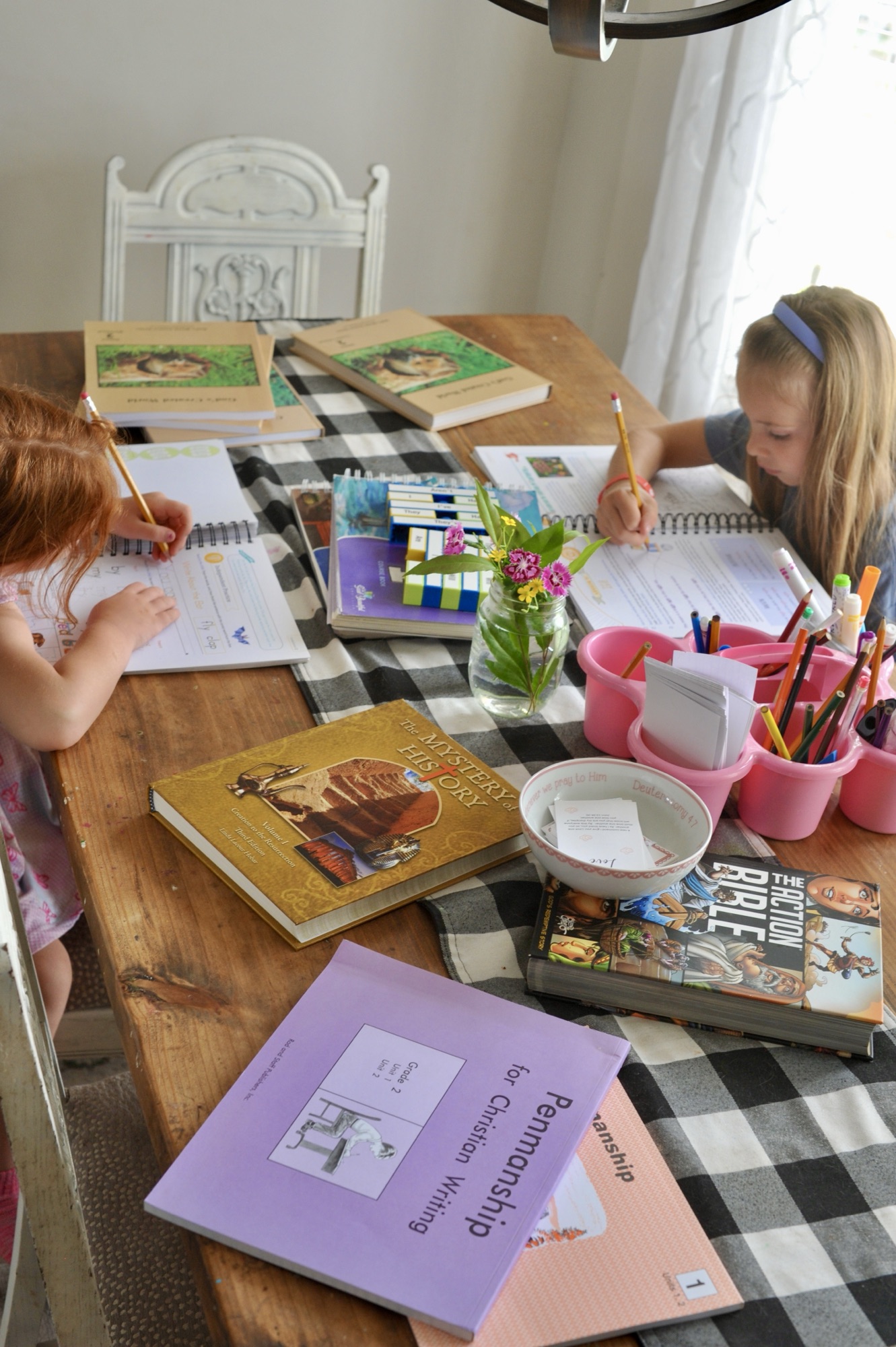
When most parents start thinking about homeschooling, they immediately fall down an internet rabbit hole. One minute you’re looking up state laws, and the next you’re comparing fifteen curriculum options, watching homeschool room tours, and wondering if you need to completely reinvent your life (and home) before you can teach your kids at home.
The good news is that homeschooling is much simpler than people expect.
You do not need a fully renovated school room (we have a hutch containing all of our homeschooling materials that lives in our master bedroom because it’s the closest room to our kitchen table and backyard – the two places where most of our learning happens), a color-coded schedule, or a perfect five-year plan before you begin. Most families figure things out as they go, and honestly, that’s how homeschooling works best. The key is starting with the practical basics instead of trying to master every homeschool philosophy and curriculum option at once.
The very first step when it comes to homeschooling is learning your state’s homeschool laws. Every state is different, and this step matters more than anything you’ll buy. Some states require paperwork or notices of intent, while others are extremely relaxed. Some ask for attendance records or yearly evaluations, and others don’t require much documentation at all. Once you know the legal requirements where you live, you can stop stressing about what’s mandatory and what’s just noise, because let’s be honest sometimes those two can feel intertwined on the internet.
After that, resist the urge to purchase an entire classroom worth of materials. Most new homeschool parents overbuy in the beginning because they’re nervous. They assume more curriculum means more success, but too much usually creates overwhelm for both the parent and the child. You really only need a few core things to start, we started with a math and language arts curriculum, a handwriting practice book, and craft materials. We slowly added in other subjects like science and history once I became comfortable teaching my kids and we had the flow of our days down. Remember you don’t have to go all in at once – you can start slow and add in additional things as you figure out how your family homeschools.
One of the most practical and beneficial things you can do early on is create a simple daily rhythm instead of a rigid school schedule. Traditional schools have strict timetables because they’re managing large groups of children. Homeschooling is different. You’re working with your own family, which means flexibility is one of your greatest advantages but you don’t want to throw caution to the wind because then your school work may never happen.
A homeschool day might look as simple as:
- Breakfast and Bible reading
- Independent Play
- Language Arts and Math
- Lunch and Reading
- Writing and Science or History
- Crafts and Play
That’s enough. You do not need to fill eight hours to create a meaningful education. In fact, many new homeschoolers are shocked by how quickly focused learning can happen at home without classroom distractions.
It’s also important to understand that homeschooling will never look perfect, and the beginning can be a challenge. There’s usually an adjustment period for everyone. If your child has been in traditional school, they may need time to decompress and settle into a new routine. Some kids are excited immediately, while others test boundaries or struggle with the transition. Parents go through their own learning curve too. Teaching your own children is different than supervising homework after school, and it takes time to build confidence.
This is why simplicity matters so much in the beginning. The easier your systems are, the easier it is to stay consistent. Instead of trying to recreate school at home, focus on building a calm, sustainable home life where learning becomes part of the rhythm of your day.
Another practical step that helps tremendously is finding community early. Homeschooling feels much less intimidating when you realize other families are figuring it out too. Look for local homeschool groups, co-ops, library activities, sports programs, or park meetups. You don’t have to join everything, but having connections with other homeschool families can make the transition feel much more normal and manageable.
And maybe the most important practical advice is this: give yourself permission to change things. If a curriculum isn’t working, switch it. If your schedule feels exhausting, simplify it. If afternoons are always a disaster, move lessons to the morning. Homeschooling works best when families stay flexible instead of trying to force a system that clearly isn’t serving them.
Most experienced homeschool parents will tell you that they learned far more during their first year than they ever did while researching beforehand. You learn by doing. You learn by observing your children. You learn by noticing what works and what doesn’t.
So if you’re feeling overwhelmed about how to begin, strip it back to the basics:
- Learn your state laws
- Choose simple core curriculum
- Create a loose daily rhythm
- Keep expectations realistic
- Stay flexible
- Give your family time to adjust
You do not need to have homeschooling mastered before you start. You just need to begin.
Leave a Reply